
The disciplines of carom billiards
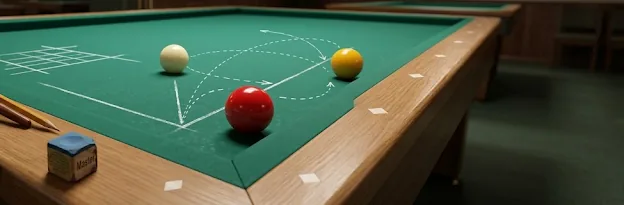
Carom billiards isn't a single game: it's a family of disciplines that share the same table and the same three balls, but not the same way of scoring points. This site mainly teaches straight rail, one-cushion (One-cushion system) and three-cushion (System 4, Conti system) — here's the overview. To find out where it all comes from, head to a bit of history.
The disciplines
Straight rail (partie libre)
The learning format: every contact of your cue ball with both object balls scores a point, with no cushion requirement. See the detail in Rules of the game.
Balkline (47/1, 47/2, 71/2)
Lines drawn at a fixed distance from each cushion divide the table into zones: once a quota of points scored within the same zone is reached, a ball must be sent out of it. Three widths exist — the quotas are detailed in Rules of the game. A late invention: balkline was created in the 1880s to contain a scoring technique that let players run up points almost endlessly in straight rail (see the history).
One-cushion
The cue ball must touch at least one cushion before the second contact. This is the system taught on this site under the name One-cushion system.
Three-cushion
The cue ball must touch three different cushions before completing the carom — the most technical and most widely followed discipline in carom billiards. Two calculation methods are taught here: System 4 (one reference cushion) and Conti system (four cushions).
Artistic billiards
Set shots (direct carom, bricole, casin...) to be completed a fixed number of times, on precise ball positions. A discipline of pure precision, judged on whether each shot succeeds rather than on a running score.
Five pins (Italian billiards)
Five pins (one red, four white) arranged in a cross (the "castle") at the centre of the table: each shot combines points from knocked-over pins and caroms. Very popular in Italy and Latin America, also played competitively in France.
Four-ball games
A fourth ball, the blue one, offers many more ways to score: it is the ideal ground for beginners or for playing between different levels. The federation offers three versions of increasing difficulty, with the same four balls (white, yellow, red, blue). The player who starts plays the white, the second player the yellow.
Four balls, ball in hand
For complete beginners. You score a point by touching at least two of the other three balls, whatever their colours and the order. Before each shot, the player places their ball wherever they like, about 6 cm from the cushion (roughly one ball). Point scored: they put their ball back near the cushion and play again; point missed: the turn passes. The winner is the first to reach the total set for the game, from 20 to 40 points depending on the time available.
Four balls, classic
For beginners who already have about twenty hours of practice. Same way of scoring (at least two balls touched), but you play your ball where it lies. Point scored: you play again from the new position; point missed: your opponent plays from the situation you leave them. Same total to reach, from 20 to 40 points.
La Bleue
An even more playful version, for beginners and more experienced players alike: it partly evens out differences in level. The start is the same as in classic four-ball, but you accumulate points according to the kind of shot (table below). You need to total 50 points.
| Case | What you must achieve | Points |
|---|---|---|
| A | Carom (direct or with one cushion) on two balls among the white, the yellow and the red | 1 |
| B | Carom (direct or with one cushion) on two balls including the blue | 2 |
| C | Carom with two, three or more cushions: the points of A or B multiplied by the number of cushions (× 2 or × 3) | A or B × cushions |
| D | Three cushions before touching a ball, no carom | 3 |
| E | Three cushions before touching the blue, no carom | 5 |
| F | Carom after three cushions, on two balls among the white, the yellow and the red | 10 |
| G | Carom after three cushions, on two balls including the blue | 15 |
| H | Carom on the other three balls (yours touches all three) | 20 |
Five pins: how to score
A game is played in sets (usually 60 points, the distance can change). Players take one shot each and must touch the opponent's ball first. The castle is made of the red pin in the centre and four white pins placed around it, 66 mm from the centre; it is set out with the pin placer or, failing that, by leaving the width of one ball between two pins.
| Successful shot | Points |
|---|---|
| Each white pin knocked down by the opponent's ball that you sent | 2 |
| Red pin knocked down together with other pins | 4 |
| Red pin knocked down alone | 10 |
| Opponent's ball sent to carom on the red | 3 |
| Your ball carom on the red after touching the opponent's ball | 4 |
If your own ball knocks down at least one pin, all the points go to your opponent. Also counted as fouls: playing the wrong ball, not touching the opponent's ball, touching the red first, knocking down a pin before touching the other ball, or touching a pin or a ball with the cue or your body. After a foul, the opponent receives all the points scored plus 2 points, and gets a free shot.
Playful games
Casin
A variant that combines several kinds of points. Each player announces in advance the set figure they will play: for example playing with the hand that is not their natural hand, or making a single cushion before the point counts.
Pétanque
The rules are inspired by pétanque, for two players or teams of two, with several sets of balls (four coloured balls per player or team). Shots are played from a zone between the bottom short cushion and the second diamond. The first player sends the white ball, which acts as the jack, beyond the line, and it must touch the top cushion. They then play one of their balls to place it as close as possible to the white; the opponent tries to do better. Whoever fails plays again until they succeed or have no balls left. A ball that comes back behind the line is removed from play; if it is the white, the opponent scores 4 points. You count the largest number of balls from one group that are closer to the white than the opponent's: the first to 8 points wins, over several rounds (other sources count one point per ball and play to 13 points, as in classic pétanque: it is best to agree before you start). Variant: propel each ball placed in the starting zone with a second white ball.
Bouchon (or "mushroom billiards")
Very popular in cafés in the south-west of France until the 1990s. It is played with just two balls (the red and the white) and three pins. The aim: knock down only the centre pin with the red ball, after making at least one cushion.
And pocket billiards?
To place French billiards (the kind this site is about) among the other big families, here are the four main games. The playing surfaces shown are those read from the panels of the Billard Club de Bouaye.
| Game | Pockets | Balls | Principle | Playing surface |
|---|---|---|---|---|
| American pool | 6 | 16: 15 numbered balls from 1 to 15 and the cue ball | Pocket numbered balls; in nine-ball, whoever pockets the 9 wins | 2.54 m by 1.27 m |
| Blackball (English pool, 8 pool) | 6 | 7 reds, 7 yellows, 1 black (no. 8), 1 white | Pocket your 7 colour balls (reds or yellows), then the black | About 1.85 m by 0.94 m |
| Snooker | 6 | 15 reds, 6 colour balls, 1 white | Pocket a red, then a colour, alternately; the balls have different values, hence the strategy | 3.57 m long |
| Carom (French billiards) | none | 3: the white, a yellow (or spot) and a red | With your ball, touch the other two in a single shot, in any order | 2.84 m by 1.42 m (competition table) |