
A bit of the history of carom billiards
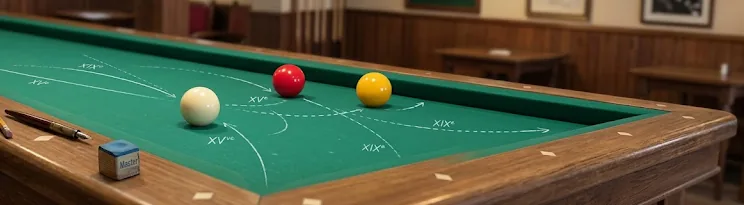
This page completes the tour of carom billiards' disciplines: where the game comes from, and how the rules played today took shape over time.
Carom billiards descends from an outdoor game played in the Middle Ages with mallets and wooden balls, known under several regional names. It is thought to have moved indoors, onto a table, around the 15th century; balls were then pushed with curved sticks, ancestors of today's cue.
The milestones at a glance
| Milestone | Event |
|---|---|
| 15th century | The game moves from outdoors to an indoor table. |
| 1634 | The word "academy" is used for the first time for a billiard room. |
| 1674 | Earliest known engraving showing a six-pocket table. |
| 1770 | A third ball (the red) is added, making three-ball caroms possible. |
| 1807 | First written, formalized rules. |
| 1807 | The leather tip at the end of the cue is presented in Paris (some sources date it to 1823 instead) — before that, the ball was pushed or struck with a flat mace. |
| 1826 | In England, a table maker replaces wood with slate as the playing surface, for lasting flatness. |
| 1835 | Rubber cushions replace the older cushions stuffed with felt; vulcanized rubber, more resistant to cold, follows in 1845. |
| Around 1860 | Tables start to be heated (oil, then gas in 1900, electricity from 1925). |
| 1868 | Celluloid replaces ivory in ball manufacturing. |
| Around 1875 | Split in styles: the English version focuses on pocketing and gives rise to snooker; the French version stays pocket-free, centred on the carom. |
| 1880s | A scoring technique discovered in the United States lets players run up points almost endlessly in straight rail; balkline is created to contain it. |
Three-cushion then established itself as the most demanding discipline in carom billiards — which is why this site devotes two calculation methods to it rather than a single universal system.
These milestones come from several public sources on the history of billiards, cross-checked against each other; the oldest dates sometimes rest on reported tradition rather than a surviving period document, and should be taken as landmarks, not absolute certainties.
The story step by step
Before the 15th century: a game played on the ground
We picture billiards in a hushed room with a green, or even blue, cloth. Yet before it was played on a table, the game was played right on the ground, like a form of croquet with hoops: wooden balls about ten centimetres across were pushed with a curved stick. England, Italy and Spain had roughly identical rules, and each country had its own name for the stick: baliyard in England, velorto in Spain, biglia in Italy, lihard in France. This lasted about two centuries; then, in the 15th century, the game moved up onto tables while keeping most of its principles.
From the 15th to the 16th century: billiards reaches the courts
Between the 15th and 16th centuries, billiards is a much-loved pastime at the courts of Europe. In France, the history of "today's" billiards is often said to begin under Louis XI, a great croquet enthusiast. According to tradition, in 1469 the king suffered from an incurable backache: so as not to give up his favourite game, he is said to have asked his carpenter to build him a raised playing ground at man height. That would be the first billiard table.
The tale also reports fine details: a table of 8 feet by 4, very heavy (618 livres), a slab of stone covered with four ells of Elbeuf cloth, at a price of 317 livres parisis, 7 sols and 6 deniers — enough, it is said, to buy a fine country house. We give this as tradition, not as established fact.
The game really enters everyday life between 1550 and 1630. Paris then has 120 to 150 tables, in four sizes: 12 feet by 6 for the largest, 10 by 5, 8 by 4, and even 6 by 3 for the smallest (the foot was about 32 cm). It is played in noble and middle-class homes alike, and also among schoolboys and servants.
The 17th century: academies and the king's court
On 16 May 1634, the word "academy" is used for the first time for a billiard room. Cardinal Richelieu, who loved the game, set up the Royal Academy in 1636, rue Vieille-du-Temple, for the nobility. He devoted 22,000 livres to the education of 20 sons of poor gentlemen, housed free of charge, and of 50 other younger sons who paid board. The programme included military exercises, mathematics, history, fencing… and billiards, a full knowledge of which was required at the leaving examinations that opened the door to the King's Musketeers.
Louis XIV played too: a 17th-century print, titled "Third apartment", shows him playing billiards with relatives and nobles. The king held evenings at Versailles around the playing table and preferred billiards to real tennis (jeu de paume).
In 1680, a wool weaving mill opens in Verviers (Belgium). The cloth made there allowed the game to evolve and brought it closer to the one we know.
The 18th century: from the mace to the cue
Between 1670 and 1720, players begin using the butt end of the mace: they turn it round to push the ball with the handle. This is the birth of the billiard cue. At first it is seen as a "skilled player's trick", not yet common practice. The mace does not vanish overnight: around 1800, cues without a foot spread, but the mace stays in use for a good part of the 19th century.
Why the change? When a ball was too close to the cushion, the best players were allowed to use the back of the stick to free it, despite the risk of tearing the cloth. Since this method allowed more precise aiming (you can lean over the cue), more and more players took it up. To limit tears, the cue was bevelled so that it would slide over the cloth, like the mace. The cue was then made of bare wood, with no tip: the slightest side spin caused a miscue, so every shot was played "full ball". The game took off so strongly that there were 800 billiard tables in the capital's rooms in 1790.
The 19th century: the leather tip, the real revolution
The real revolution comes with the invention of the leather tip, attributed to François Mingaud (1771–1847), a French billiards player: a hemispherical leather disc, fixed to the end of the cue and rubbed with chalk (the "Spanish white"). He is said to have developed it during a detention in Paris and to have presented it after his release, in 1807; some sources give 1823. This disc makes it possible to give the ball spin: it is the basis of modern play. Chalk (today, the "blue") prevents miscues and makes control of spin precise. In 1827, Mingaud published a reference work, Noble jeu de billard (Coups extraordinaires et surprenants). This invention marks the birth of modern billiards.
The equipment evolves too: slate replaces wood as the playing bed from 1826 (a first complete slate table is recorded in 1832), rubber cushions arrive in 1835 and vulcanized rubber in 1845. In 1840, the Palais-Royal in Paris has 40 billiard tables in use day and night.
Heated billiard tables (1860 to 1925)
From about 1860, billiard tables are heated, to the point that it becomes an emblematic feature of French billiards. The origin is practical: in the 18th and 19th centuries, rooms were often poorly insulated and poorly heated, and changes in temperature and humidity greatly changed how the balls rolled. So tables were first heated with oil lamps placed underneath (around 1860), then by gas (1900), then by electricity (from 1925). One source already places lamps under the tables around 1830, before the oil lamps.
This account is the club's, cross-checked against other sources on slate (1826), rubber cushions (1835) and the leather tip (1807). Some dates remain debated: Louis XI's table is a tradition, the leather tip is sometimes dated to 1823, and the start of heating varies from source to source.
The great champions
Section coming soon: the players who have marked the history of carom billiards, and what they changed in its rules or its practice.