
Glossary
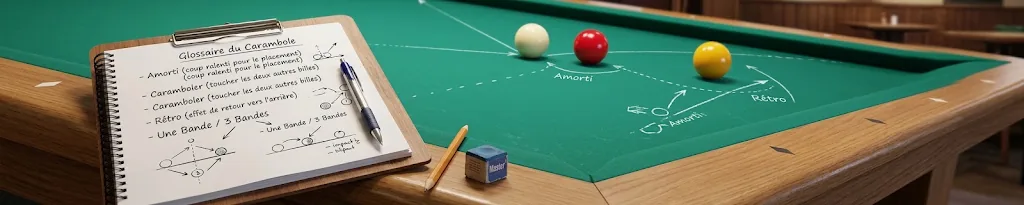
The basic vocabulary of carom billiards, to understand the lessons and talk about them with other players. The terms are listed in alphabetical order.
- Angle of reflection
- The angle at which the ball leaves a cushion. Without spin it is roughly equal to the angle of arrival; side spin changes it. All the cushion systems rely on it.
- Average
- The average number of caroms scored per inning over a game — used to rank players by category.
- Back-and-forth
- The to-and-fro of the cue just before the shot. It prepares the stroke and sets the speed: on a draw shot, the livelier it is, the faster the ball comes back.
- Balkline
- Game where lines drawn on the table mark out zones: only a limited number of points can be scored in one zone before a ball has to leave it (balkline 47/1, 47/2, 71/2).
- Ball 1, 2, 3
- Ball 1 is the cue ball (the player's own). Ball 2 is the one it strikes first. Ball 3 is the one whose contact completes the carom.
- Ball fullness
- The portion of ball 2 covered by ball 1 along the aiming line. From fullest to thinnest, five usual reference points are used: full (ball 1 covers the whole center of ball 2), three-quarter ball, half-ball, quarter-ball, and thin (contact right at the edge, minimal fullness). The fuller the contact, the more energy ball 1 transmits to ball 2; on a perfect full contact with no spin, ball 1 stops dead (see "stun").
- Bridge hand
- The supporting hand placed on the cloth or the cushion, which guides the shaft of the cue and sets the height of the hit. It must stay still during the shot (see The bridge hand).
- Carom billiards (the game)
- French billiards without pockets: three balls on a table and a single aim, scoring caroms. It is the family of games this site teaches (straight rail, balkline, one-cushion, three-cushion…). The name comes from the “carambole”, the old name of the red ball.
- Carom (the point)
- The point of the game: with a single shot, your cue ball touches both other balls. A successful carom scores a point and you shoot again.
- Chalk
- The chalk you rub on the tip before playing. It helps the tip grip the ball instead of sliding off: without it, a miscue is far more likely.
- Closed bridge
- Bridge where the thumb and index finger meet in a ring around the shaft, the middle finger supporting it. It is the most stable form.
- Cloth
- The fabric stretched over the slate. New, it plays fast and the table runs long; worn, it slows the balls and changes their paths, so the table runs short.
- Combination (rencontre)
- Shot where balls 2 and 3 are frozen together or almost: the cue ball pushes ball 2, which passes the push on to ball 3.
- Contact point
- The exact point on ball 1 struck by the tip at the moment of the stroke.
- Cue
- The stick you play with. It ends in the tip, which touches the ball; the thin front part that slides through the bridge hand is the shaft. Its length, weight and tip are chosen to suit your hand (see Equipment).
- Cue ball
- The ball the player strikes with the cue, also called ball 1. It must touch both other balls to make a carom.
- Cushion
- The rubber-lined rail around the table, off which the ball rebounds. The two long ones are the long cushions, the two short ones the short cushions. The calculation systems predict where the ball leaves after each cushion.
- Cushion-first shot (bricole)
- Shot where the cue ball hits a cushion before touching the first ball. The calculation systems (System 4, Conti, Diamond) are there to play them accurately.
- Diamonds
- Round or diamond-shaped markers set into the cushions, used as a reference for the calculation systems.
- Dominant position
- A position in which ball 1 can, with a simple shot, keep control of the path of balls 2 and 3 and return to an equally favorable position.
- Double
- Shot where the cue ball touches two different cushions before first touching a ball.
- Draw (retro)
- Shot played with a low hit: after striking ball 2, the cue ball comes back toward you. It is used to stop the cue ball and get back into position (see Draw shot).
- Exact pace
- Dosing the force exactly. Playing "to the exact pace" means exactly the power needed. Advice from the sheets: on an easy shot, never play to the exact pace — play slightly over it so as not to leave an easy position for your opponent.
- Finesse
- Very thin contact on the edge of the object ball, less than a quarter ball: ball 2 hardly deviates and the cue ball keeps almost its path.
- Follow (coulé)
- Shot played with a high hit and a ball fullness between three-quarters and full: the cue ball “follows” and keeps rolling forward after contact.
- Gather shot
- A shot meant to bring the balls together (ideally all three) to set up the next shot.
- Half-follow
- The shot in between the natural shot and the follow shot: contact is taken at roughly three-quarter ball, and the behavior is part of both.
- Inning
- A sequence of shots by the same player, from the first point attempted until the missed carom.
- Kiss
- A second contact between ball 1 and ball 2, which can either prevent the carom or, on the contrary, be used deliberately to complete it.
- Massé
- Shot played with the cue steeply raised, which curves the cue ball’s path, for instance to get around a ball in the way. It takes control: a badly played massé can damage the cloth.
- Miscue
- The tip sliding off the ball with a sharp sound. It usually comes from a lack of chalk or a contact point too far from the center.
- Moderate side
- Moderate, repeatable side spin (edge of the tip aligned with the center of the ball). Outgoing and incoming paths are nearly parallel, with little aiming correction.
- Natural deflection
- The deflection of ball 1 after a natural shot (contact in the middle, roughly half-ball): about 45°, and above all fairly constant — that is what makes the natural shot reliable and what the systems are built on.
- Natural shot
- The basic shot: a high hit and about half-ball. Ball 1 leaves with the natural deflection, around 45°, which makes it the reference for the calculation systems (see Typical shots).
- Nursing
- Playing very gently, barely grazing the balls, to keep them clustered ("in a pack").
- Object balls
- The two balls the cue ball has to touch: ball 2, then ball 3.
- Open bridge
- Bridge without a closed ring: the shaft simply rests in the groove formed by the thumb and index finger. Kept for soft shots.
- Piqué
- Shot played with the cue nearly vertical, which sends the ball back hard, over a short distance.
- Push shot
- Foul of striking the ball twice with the tip, or pushing the cue ball when it is already touching another ball.
- Rail third
- The zone near a short cushion, where gathering and controlling the balls offers more possibilities than in the central zone.
- Reversed (retourné)
- Counter-spin shot where the cue ball hits a cushion, then the adjacent cushion in the corner, and heads back toward the first one.
- Roll
- Rotation of the ball around its horizontal axis: follow roll (forward) or draw roll (backward).
- Run
- The number of caroms scored during a single inning.
- Running long / short
- A characteristic of a table: it "runs long" if calculated paths land beyond the theoretical point (new cloth, lively cushions), it "runs short" otherwise (worn cloth).
- Screened
- A position in which the balls are lined up or nearly so, preventing a direct shot with a level cue.
- Shaft
- The thin front part of the cue, which slides through the bridge hand up to the tip. Moving the bridge hand away from the ball is called lengthening the bridge.
- Side (spin)
- Rotation of the ball around its vertical axis, which changes the exit angle after bouncing off a cushion.
- Skid
- Loss of roll caused by fine dust on the balls: ball 1 "skids" slightly against ball 2 instead of rolling normally, which compromises the carom. Hence the value of cleaning the balls regularly.
- Slate
- The thick stone slab under the cloth that gives the table a perfectly flat playing surface. It is what keeps the roll regular.
- Start / End
- Numeric values (in diamonds) assigned to ball 1's starting position and to the zone it must reach to complete the carom — the basis of the cushion calculation systems.
- Straight rail
- The simplest form of the game: no cushion or zone constraint, you score points up to a total fixed in advance.
- Stun
- Ball 1 stopping dead on the spot after a full contact, for lack of forward or backward roll at the moment of the carom.
- Stun shot (amorti)
- Shot where the cue ball almost stops on contact, after passing its speed on to ball 2, which goes off to find ball 3.
- System
- A calculation method based on the diamonds, used to determine the point to aim for on one or several cushions (see the System 4 tab).
- Three-cushion
- Discipline where the cue ball must touch at least three cushions before touching the last ball. The most technical of the common disciplines.
- Throw
- Any side spin applied to the cue ball induces an opposite effect on the object ball at the moment of contact.
- Tip
- The leather disc at the end of the cue. Also used as a unit of side spin: players speak of "½ tip", "1 tip", "2 tips" of side according to how far the contact point is offset from center.
- To carom
- To score a carom, that is, to touch both other balls with the cue ball in a single shot.
- Triple
- Shot where the cue ball touches three different cushions before first touching a ball. It is the basic shot of three-cushion.
- Wide / Tight (ball)
- Ball 3 is "wide" when ball 1's possible landing zone is large (a ball close to a cushion or a corner); "tight" otherwise.